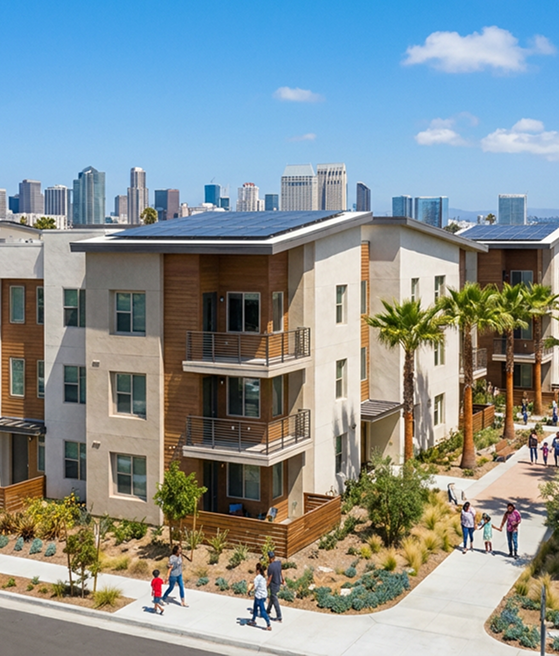
What Infill Is

Infill development is simple: it’s building new housing where the infrastructure already exists.

Instead of expanding outward into untouched land, infill puts new homes inside existing neighborhoods that are closer to jobs, transit, and services.

It uses the same streets, utilities, and schools already in place, which means faster approvals, lower costs, and less environmental impact.


In short, it’s smart growth that fixes what cities already have instead of spreading further out.

The Efficiency of Infill

  • Uses existing infrastructure
  • Closer to jobs and transit
  • Faster approvals & lower costs

Community Benefits

When done right, infill strengthens neighborhoods. It adds gentle
density with smaller-scale housing that fits within existing
streetscapes.

“Infill replaces neglect with structure, both physically and economically.”

Why It Works in San Diego

Most of San Diego is already built, but zoning rules keep new housing from being added where it’s needed most. That’s why state and city policy now favor infill and ADUs (Accessory Dwelling Units).

By-right approvals and streamlined permitting let entitled projects move faster and avoid years of delay.

By-right approvals and streamlined permitting let entitled projects move faster and avoid years of delay.

“More detailed case studies available upon request for qualified investors”.

Investor Logic

For investors, infill sits at the intersection of
stability and scale.

These projects don’t depend on speculative sprawl or
risky entitlement fights. They run on disciplined
execution and clear economics.

stability and scale.

Supply constraint = Durable yield

San Diego’s zoning cap limits competition.

Shorter timelines = Faster velocity

Entitled infill builds move faster from capital to cash
flow.

Smaller project size = Diversified exposure

More units across multiple infill sites reduce
concentration risk.

Community alignment = Lower headline risk

Public policy and public need are finally moving in the
same direction.

Got Questions? We’ve got the answers!

Investing with Fletcher Cove Capital is a simple and streamlined process. Accredited investors join our investor list, review curated opportunities through our platform, and participate in offerings that align with their goals. Once you decide to invest, we guide you through onboarding, documentation, and funding, with clear reporting throughout the life of the project.

Minimum investments vary by offering, but most opportunities typically start in the $100,000-$250,000 range. We work with investors to ensure commitments align with both the structure of the deal and their overall portfolio strategy.

Yes. Fletcher Cove Capital invests alongside our limited partners in many of our offerings. We believe alignment matters, and our compensation is often tied to performance through the back-end promote—meaning we succeed when our investors succeed.

We focus on markets where we have deep sponsor relationships, strong local insight, and long-term demographic tailwinds. San Diego and key Utah markets such as Salt Lake City and St. George continue to benefit from population growth, housing demand, and supply constraints—making them attractive regions for disciplined development investing.

Our primary focus is on ground-up development and value-driven residential opportunities, including build-to-rent and infill housing projects. We prioritize investments that are fully entitled or by-right, with defined business plans and strong risk-adjusted return potential.

We take a sponsor-first approach. Every sponsor relationship comes through trusted referrals, is met in person, and undergoes rigorous underwriting before any opportunity is presented to investors. We evaluate track record, execution capability, market expertise, capital alignment, and deal structure to ensure we partner only with high-performing operators.

Still have questions?